
Number of Participants: 20-25
Age of Participants: 5 – 12
Time Allotment: 90 minutes
Required Supplies/Equipment
- Q-tips
- Watercolor paint
- Watercolor paper
- Printouts / examplesof pointillism art (see below)
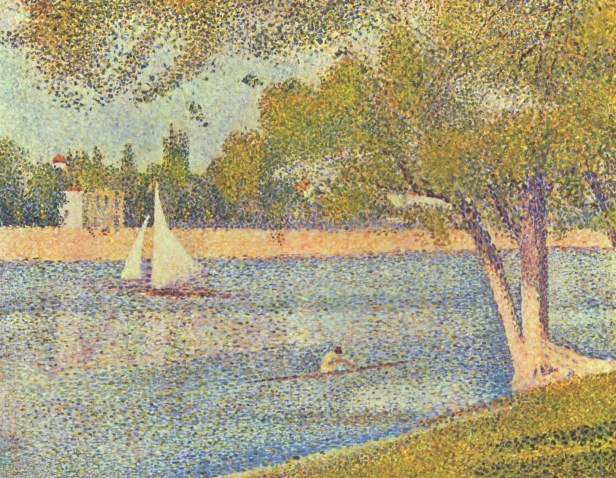
Objective: Learning about the style of art known as pointillism and the artist (Georges Seurat) who created it
Class Breakdown:
- 5 minutes of introduction of activity, demonstration, and expectations
- 20 minutes of history & background information on pointillism, visual displays and examples, time for questions and answers.
- 30-45 minutes of activity
- 10 minutes clean-up
Instruction:
- Begin by discussing some background information on Pointillism, and its founder Georges Seurat with students. Specifically, his use of dots to make paintings and his use of primary colors placed next to each other instead of mixing colors.
- Pointillism is often considered part of the Post-impressionist movement. It was primarily invented by painters George Seurat and Paul Signac. While Impressionists used small dabs of paint as part of their technique, Pointillism took this to the next level using only small dots of pure color to compose an entire painting.Some Characteristics of Pointillism:Unlike some art movements, Pointillism has nothing to do with the subject matter of the painting. It is a specific way of applying the paint to the canvas. In Pointillism the painting is made up entirely of small dots of pure color.
- In many ways Pointillism was as much a science as an art. Pointillism used the science of optics to create colors from many small dots placed so close to each other that they would blur into an image to the eye. This is the same way computer screens work today. The pixels in the computer screen are just like the dots in a Pointillist painting.
- Georges Seurat – Seurat was the founder of Pointillism. He studied the science of colors and optics to invent this new technique.
- Paul Signac – Signac was the other founding father of Pointillism. When Seurat died young, Signac continued to work with Pointillism and left a large legacy of artwork using the style.
- Seurat called the style of painting Divisionism when he invented it, but the name was changed over time.
- The smaller the dots, the clearer the painting and the sharper the lines, just like with the screen resolution on a computer monitor.
- Vincent Van Gogh experimented with the Pointillism technique. It is evident in his 1887 self portrait.
The style often used dots of complementary colors to make their subjects more vibrant. Complementary colors are colors of the opposite hue, for example red and green or blue and orange.
- Tape the edges of the paper with drafting tape.
- Sketch basic landscape with a pencil. Seurat’s River Seine can be used as inspiration
- Wet the paint with a brush, dip the Q-tip® in water and dip it into the paint.
- Pressing down lightly will make a small dot, more pressure will create a larger one.
- Have the students try to fill up as much of the paper as possible with color.
- Remove the tape when the painting is dry.
Core Values/Life Skills: Creativity, art history/cultural enrichment, responsibility
 Cultivate a Kindergarden